
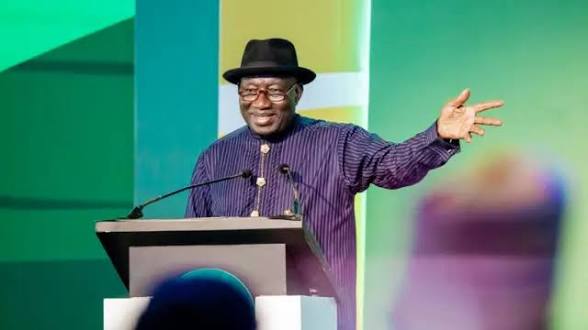
Former Nigerian President Goodluck Jonathan has called for greater involvement of young people in leadership and decision-making across West Africa, warning that excluding them could undermine efforts to achieve lasting peace, stability and development in the region.
Jonathan made the speech while delivering the keynote address at a Regional Youth Leadership Training on Peace and Security organised by the Economic Community of West African States (ECOWAS) in Accra, Ghana.
The two-day programme, held from October 29 to 30 at the Kofi Annan International Peacekeeping Training Centre (KAIPTC), was organised through the ECOWAS Commission’s Directorate of Political Affairs in collaboration with the West Africa Network for Peacebuilding (WANEP) and GIZ.
Speaking on the theme, “Transforming Youth Leadership and Policy Action to Advance Peace, Security and Community Resilience in West Africa,”
Jonathan stressed that young people should not be treated merely as beneficiaries of peacebuilding programmes but recognised as active participants in shaping the region’s future.
He highlighted their contributions to social justice, national transformation and Africa’s development, adding that youth empowerment should be a shared responsibility.
Jonathan’s remarks come as West Africa continues to grapple with violent extremism, political instability, unconstitutional changes of government, electoral tensions, climate-related insecurity and socioeconomic exclusion. With young people accounting for approximately 60 per cent of the region’s population, the training emphasised the importance of giving them meaningful opportunities to contribute to conflict prevention, peacebuilding and governance.
Earlier, the Commandant of KAIPTC, Air Vice Marshal David Anetey Akrong, urged participants to translate the knowledge gained during the programme into practical action in their communities.
“The true measure of this training will not be the number of participants trained, but the positive impact you make in your respective communities,” he said.
Representing the ECOWAS Commission, Dr Onyinye Onwuka, Head of Mediation and Coordination at the Regional Political Affairs Division, said advancing the Youth, Peace and Security Agenda required sustained mentorship, institutional support and meaningful youth participation in security-related decision-making.
She also called on development partners to support the implementation of initiatives and action plans developed through the programme.
Similarly, Dr Mohamed Ibn Chambas, former President of the ECOWAS Commission and African Union High Representative for Silencing the Guns in Africa, encouraged participants to demonstrate leadership through dialogue, trust-building and positive action within their communities.
The training equipped participants with skills in leadership, conflict transformation, advocacy, entrepreneurship, mentorship and regional networking to help them address community challenges and support peacebuilding initiatives.
At the end of the programme, participants were encouraged to become ambassadors of peace and security by applying their knowledge and networks to community-based initiatives.
Through the programme, ECOWAS and its partners reaffirmed their commitment to ensuring that young people have a meaningful role in shaping peace, security and development across West Africa.

Cami Ezenwa is a Writer, Editor, Publicist, Biographer and Journalism Trainer
He has worked with the Daily Times, Daily Independent, Financial Standard and Business Television to mention some.
His ongoing Corporate Communications Master Class training series equips learners with credible hands-on skills for effective Media Relations, Public Communications & Corporate Affairs amongst others.
He can be contacted via 09165809519 or 08180335778.