
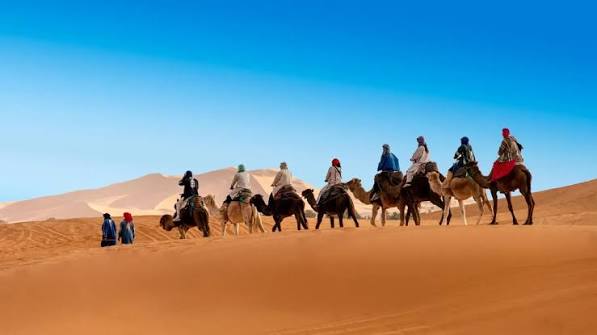
What is the Trans-Saharan Trade? The Trans-Saharan Trade was a network of trade routes that crossed the Sahara Desert, linking North Africa with West Africa.
It flourished from around the 8th century and facilitated the exchange of goods, culture, religion, and ideas between different regions.
What Goods Were Traded In The Trans Sahara Trade?
West Africa exported: gold, kola nuts, ivory, slaves, and leather goods. North Africa exported: salt, textiles, horses, weapons, beads, and manufactured goods.
How It Was Organised?
The trans Sahara trade was mainly organised through a Caravan System, whereby traders traveled in large groups called caravans for safety and support.
Camels were used because they could survive long desert journeys with little water.
Trade Routes
Well-established routes connected major trading centers such as Timbuktu, Gao, and Kano with North African cities like Tripoli, Fez, and Cairo.
Middle Men And Merchants
Merchants and brokers facilitated the buying and selling of goods. Local rulers often regulated trade and collected taxes. Caravans stopped at oases to rest, obtain water, and trade. Powerful empires such as the Mali Empire and Songhai Empire provided security for traders and maintained order along trade routes.
READ ALSO: Nigeria’s First Military Coup Of 1966: Factors, Actors, Lessons
READ ALSO: RSS Makes History With First-of-Its-Kind University-Style Graduation Ceremony
Importance Of The Trans Sahara Trade
The Trans Sahara trade increased wealth and prosperity in West African kingdoms and promoted the spread of Islam in West Africa. The trade encouraged cultural exchange and the growth of cities such as Timbuktu. It strengthened political and economic ties between North and West Africa.
In summary
The Trans-Saharan Trade was the exchange of goods across the Sahara Desert between North and West Africa, organised through camel caravans, established trade routes, merchant networks, and the protection of powerful African kingdoms and empires.
These Are The Key Factors Of The Trade:
Environment, Gold, Horses, and the Organisation of the Caravan Trade
One of the major elements in the creation of trade networks is geography.
Trade tended to be in products which cannot be found in one area, and which are exchanged with those which are needed in another.
For example, societies living in areas with forest products can exchange them for salt from desert areas, and grain crops from savannah areas.
In turn, savannah and desert peoples can acquire forest products. Thus, a vital factor in the emergence of the social fabric of West Africa was the Sahara desert.
Where the geographical barriers between different climate zones are extensive, the trade networks needed to move goods have to be more complicated. In order to thrive, societies needed to develop new means of accommodating the traders.
Where the barrier is as large as the Sahara desert, or the Atlantic Ocean, the social fabric will become intertwined with these complex trading networks.
This occurred in West Africa with the trans-Saharan trade; and the social frameworks which emerged with this trade then became influential in shaping the early trans-Atlantic trade. So it is hard to understand the importance of trans-Saharan trade without understanding its importance for society, in terms of organisation and belief.
One important climatic factor in the shaping of West African societies was the spread of the tsetse fly. In humid forest zones, the tsetse fly which causes Sleeping Sickness meant that it was hard for pack animals to survive.
Camels, horses, donkeys, and the like could not easily survive in areas where the tsetse fly could live and thrive.
This meant that society had to be organised so that people would fulfill that role, and be able to carry headloads of gold, kola nuts, ivory, and more. This became significant as the trans-Saharan gold trade became ever more important from the 11th century onwards.
The Dynamics of Trans-Saharan Exchange (1000–1600 A.D.).
This graphic outlines the primary trade networks connecting West African commercial hubs like Timbuktu, Kano, and Bornu with North African destinations. It highlights the major commodities exchanged, including the northbound movement of gold and enslaved populations alongside the southbound import of manufactured goods, horses, and Islamic scholarship.
Submitted as an assignment by Temitope Kolawole, David Okoro Sokoh, Williams Ayomide Racheal, Ideji Kelvin Osaivbie, Isiaka Munirat Abiodun& Angela Oghare Chineye, for History And Politics Of Nigeria, Course Code: Mac 118
