
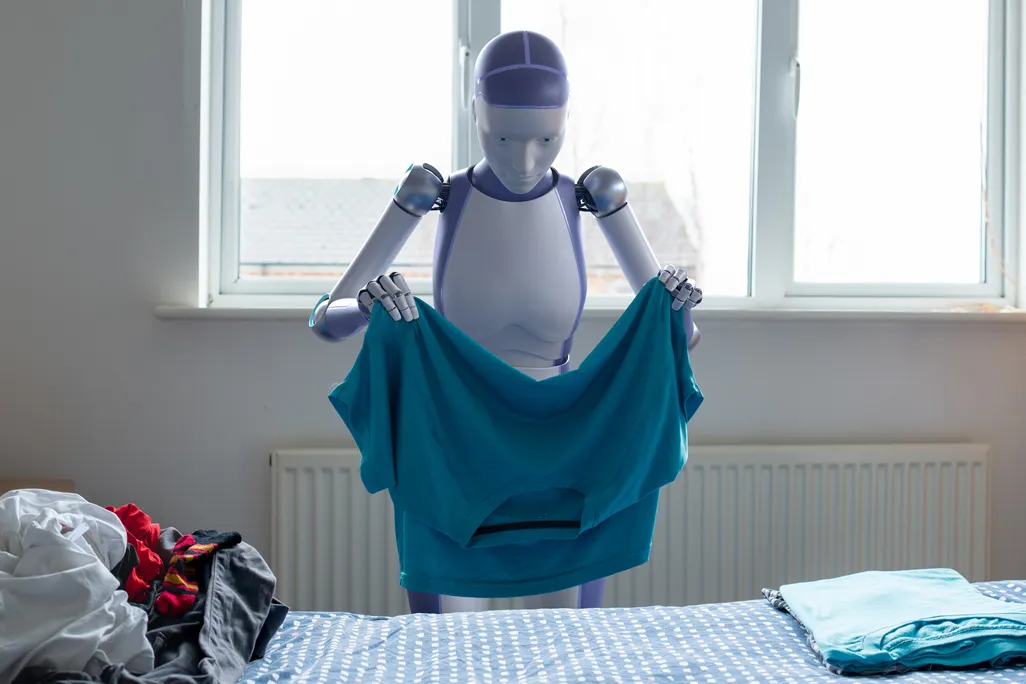
Though robots still struggle with the unpredictable ways that fabric crumples and creases; however newer approaches appear to offer the hope of better robotic household help
More than 60 years ago, Rosie the Robot made her TV debut in “The Jetsons,” seamlessly integrating herself into the Jetson household as she buzzed from room to room completing chores.
Now, as reality catches up to science fiction and scientists work to develop modern-day Rosies, one of the most mundane tasks is proving to be a big challenge: folding laundry.
The ordinary-seeming act of picking up a T-shirt and folding it into a neat square requires a surprisingly complex understanding of how objects move in three dimensions.
Our own ease in accomplishing such tasks comes from a learned understanding of how different fabrics will respond when folded, even if we haven’t folded them before, but robots struggle to apply what they learn to new situations that may differ from their training. As a result, current robots are slow and often perform poorly on even the simplest of folding tasks.
Now, however, newer approaches that adapt better to real-world scenarios may lay the groundwork for robots folding our laundry in the future.
A big challenge in teaching robots the skill is the infinity of ways that various fabrics can fold. Think about all the times you’ve tossed a T-shirt into the laundry basket and how it landed in a slightly different-shaped heap each time.
READ ALSO: Robotics And Coding: What Digitech Academy Did With 500 Innovators
READ ALSO: Dyslexia: How To Help Your Child Overcome This Common Learning Disability
It’s simple for people to pick up a shirt and quickly find a sleeve or collar to orient themselves, but every unique way a shirt crumples is a new challenge for robots, which are often trained on images of unwrinkled clothing lying flat on a surface, with all features visible.
“It’s not the fabric itself that is the challenge. It’s the amount of variations that can be created by the way fabric can be crumpled, and all the different kinds of clothing items that exist,” says David Held, a robotics researcher at Carnegie Mellon University in Pittsburgh.
Today’s robots often use a strategy called “pick and place,” in which the robot uses a pre-determined move to manipulate fabric. This often fails to result in a good fold, because soft fabric can crumple or distort unexpectedly.
