
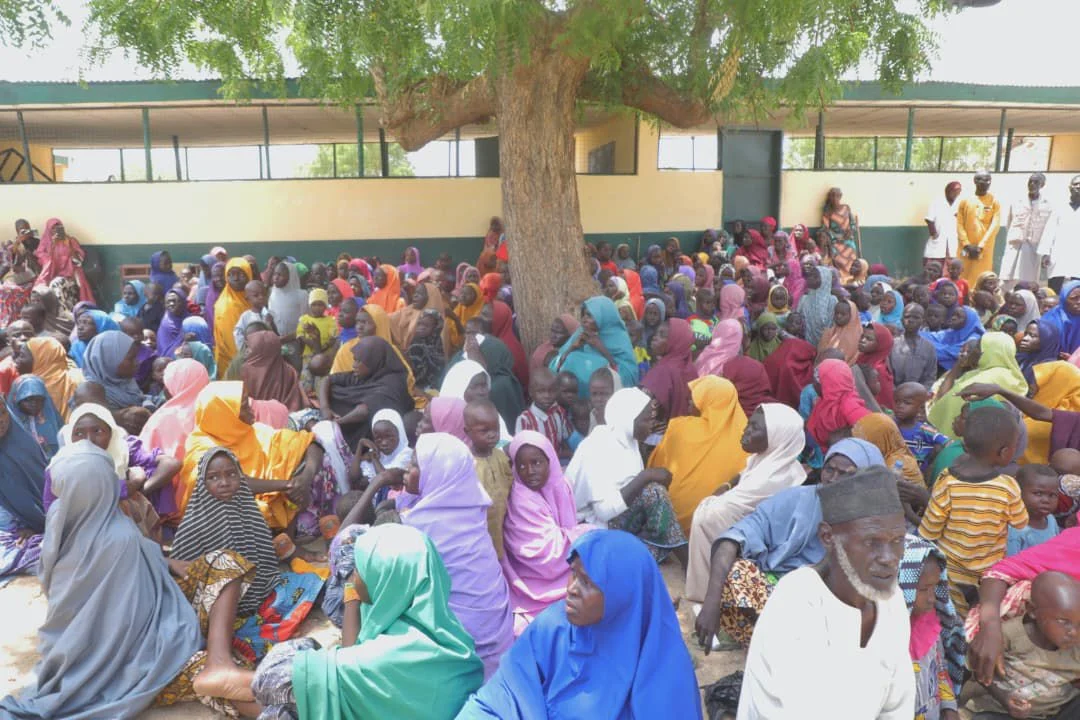
Freed victims of a recent mass abduction have been narrating their harrowing ordeals in captivity.
They were part of the 400 people, including women and children abducted from Gwoza Local Government Area of Borno State before being reunited with their families.
A female victim, Aisha Bukar, who said she spent three months and two weeks in captivity recounted:
“Throughout our stay, we survived on raw corn soaked in water, which we ate only once a day. That was how we lived for three months,” she said.
“My stomach is not accepting cooked food now. My children are also having stomach ache after eating some of the food in the camp,” she said.
Another person who also recounted harrowing ordeals in captivity is, Hafsat Musa.
She told of how she was beaten at the point of abduction in Ngoshe before being taken into the mountains, and how she lost her three children and husband during the capture.
Musa added that the captives were later moved to a large cave in the Mandara Mountains, where they were forced to sleep on bare ground without food or access to bathing.
“We were kept there without food or bathing. We all suffered hunger and starvation. Sadly, in the three months and two weeks I spent there, I lost my three children and my husband,” she said.
She added that she only learned of her husband’s death after her release.
“When the Boko Haram leader sent food, his subordinates often diverted it and shared it among themselves, leaving us hungry. Our clothes and hair became very dirty and full of lice,” she said.
Musa expressed gratitude to God for her release and thanked Governor Zulum for facilitating their freedom, while urging others to accept their experiences as fate.
“One of my neighbours also lost four out of her seven children. She only learned about it when we arrived in Pulka,” she added.
READ ALSO: Bandits Kidnap 50 Elders Who Came To Them On Reconciliation Meeting
READ ALSO: Oyo State Demolishes Building Used By The Adelabu Kidnappers
Zainab Abubakar, a freed mother of two, said they were only fed once a day.
“We thank God for His mercies and pray that the remaining victims will be freed soon,” she said.
Most of the victims interviewed said their accounts reflect what those still in captivity are currently enduring in the hands of the terrorists.
One male victim, Idrissa Mustapha, said he was taken from his home in Ngoshe in March while he was breaking his fast. Unlike others, Mustapha said he was treated well by the leader of the insurgents.
“I was taken to the Amir’s house, and I used to eat food three times a day. The Amir saw me among several women, so he asked me to follow him to his house.
“We ate together and prayed together. I thank God and our security agencies for securing our lives,” he said.
“He treated me with respect, and I was not molested or mistreated throughout my stay, but I chose to leave the camp when I was given the option. Yes, some people stayed back,” he added.
