
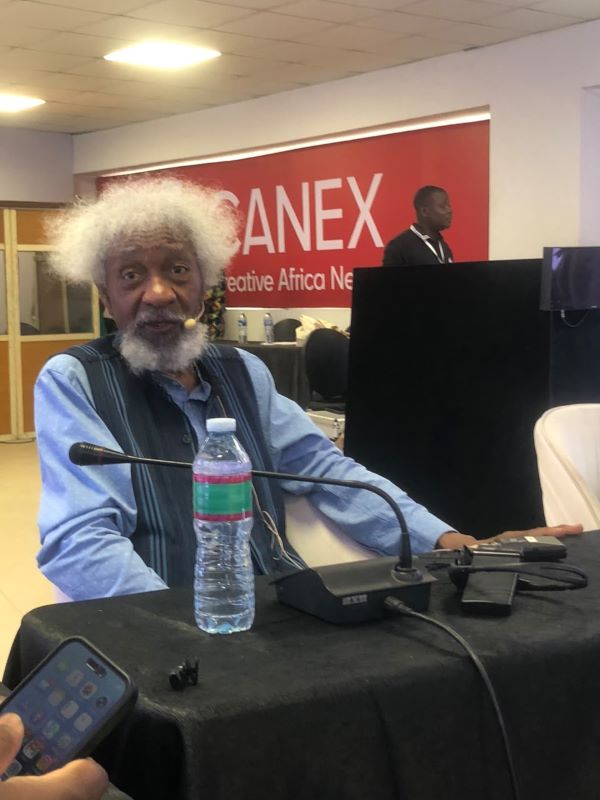
Nobel laureate Professor Wole Soyinka has warned against uncontrolled technology and artificial intelligence use, saying this could result to self-destruction
He has also called for an uncompromising defense of freedom, while telling young people to stop taking life too seriously
Soyinka made the remark during a panel session on Book Reading and Signing with his publisher, Bankole Olayebi, at the ongoing Creative Africa Nexus (CANEX) WKND 2026, organized by Afreximbank in Lagos, on Friday.
The session was part of the 20th anniversary celebration of his memoir, You Must Set Forth at Dawn, coming 40 years after he became the first African to win the Nobel Prize for Literature.
The Nobel Laureate insisted that the book was never meant to be a private life story but a testimony to courage, conviction, intellectual freedom and the enduring struggle for justice and human dignity.
READ ALSO: JUNE 12: TINUBU’S PORTRAIT OF LOYALTY VS BUHARI’S DIVERSIONARY TACTIC
READ ALSO: BREAKING: FG Bans Honorary Degree Holders From Answering Dr
He said instead that it was impossible to have written a more personal, private account separated from Nigeria’s turbulent political history, because even his earliest idea for the book was not about himself but about recapturing a world that was disappearing the world of his uncle, the Rev. I.O. Ransome-Kuti.
Describing his uncle as fascinating, a phenomenon and a power of nature who was eccentric and at the same time very methodical, he also recalled how the man would give him six strokes of the cane if he failed to distinguish between bad grass and good grass while clearing the compound.
He also recalled how he had told his uncle as a boy that he would one day write about him, only for his uncle to die soon after.
He said he forgot the project for years until he later understood that what he wanted to recapture was not just a man but a whole transitional society, its theatrical culture, its music, its sound, its smell and its dialogue, and that he had to wait many more years for what he called a partial total recall in order to recover that child’s voice.
When asked whether, 20 years later, the book is still an accurate portrait of the man who wrote it, Soyinka did not give a simple yes or no, but returned to his central theme that looking into the past is not about nostalgia but about extracting something productive from it to move forward, advising the audience not to give up but to look into the past with every intention of extracting productively from it.
On life advice for young people, Soyinka said he finds giving advice dangerous.
“Going further, going as far as offering an advice, I consider it very dangerous,” he said. He explained that he often looks through the window of his fourth-floor apartment at a school outside, watching children running around, playing football, basketball and other games, and remembering that he was once like that.
“If I had to offer an advice to them, I would say, listen, don’t take anything too seriously. Just make sure you pass your exams, and you decide early enough what you would like to become as an adult,” he said.
“Because that in itself is a creative process. You change your mind about 20 times every year. And enjoy that. Enjoy the fantasy of being this, a lawyer.”
On technology, Soyinka said like all humanists he is always fascinated by technological developments, because they are generally from human intelligence.
“There is no photogenic thing that I know in the world. It’s all the work of human beings,” he said. “And so it’s an absurdity to have the creation of a fundamental technology that somehow begins to dictate to humanity.”
He warned: “For me, this is suicide. And this is encouraging suicide. I think most of the world refuses to be compelled to commit suicide. And so we have to manage technology.”
He argued that humanity must introduce “philosophical inquiry into the extent to which we encourage the autonomy of the instrument, yeah, technology,” because anything can be abused by humanity.
